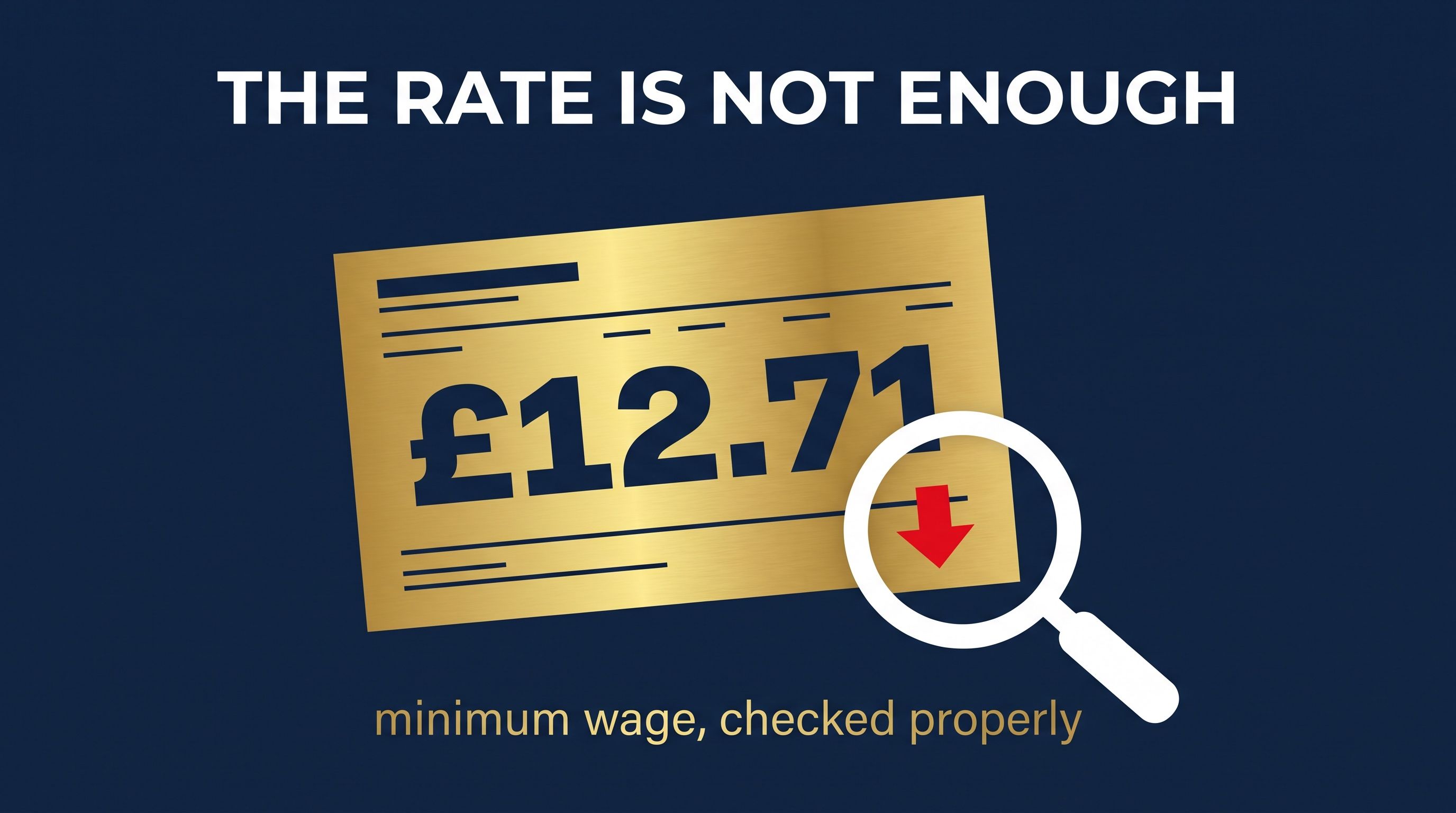
On 3 September 2026, the government published its latest list of employers who failed to pay the minimum wage: 658 of them, ordered to repay around £4 million to more than 27,000 workers and fined a further £7 million. The names included B&Q, Five Guys, Serco and Whitbread. These are not businesses that pay £9 an hour and hope nobody notices.
That is the point of this article. Since April the National Living Wage for workers aged 21 and over has been £12.71, and most employers pay it. But minimum wage law does not test the number on the payslip. It tests what the worker is actually left with, for every hour actually worked, after deductions the law says count against pay. Several of the companies named this month blamed "technical" payroll errors. Here are the traps that catch small employers most often.
In a nutshell
- The rate is only the starting point. £12.71 for 21 and over, then the real calculation begins.
- Deductions can pull pay below the line. Uniforms, tools and job expenses always reduce minimum wage pay.
- Salary sacrifice counts against you. So do tips, which never count towards the minimum.
- Unpaid minutes are unpaid hours. Opening up, closing down, travel between jobs, training.
- Salaried staff can be underpaid too. Extra hours dilute a fixed salary.
- Apprentice and age rates expire. Birthdays and first anniversaries change the rate.
1. The rates, and why the headline figure is not enough
From 1 April 2026 the rates are £12.71 an hour for workers aged 21 and over (the National Living Wage), £10.85 for 18 to 20 year olds, and £8.00 for under 18s and apprentices. The accommodation offset, the only benefit in kind that can count towards pay, is £11.10 a day.
Minimum wage compliance is not "did I pay the rate". It is a calculation: the worker's minimum wage pay for the pay reference period, divided by the hours that legally must be paid for. If deductions reduce the top of that fraction, or unpaid time inflates the bottom, a payslip that says £12.71 can describe a worker being paid £12.20. HMRC, which now enforces the rules on behalf of the new Fair Work Agency, checks the calculation, not the headline.
2. Uniforms, tools and other deductions
This is the classic trap in retail, hospitality and care. If you require staff to wear particular clothing, use particular tools or carry particular equipment, and the cost comes out of their wages, that deduction reduces minimum wage pay. Gov.uk is unambiguous: such deductions "will always reduce minimum wage pay". The same applies to expenses the worker incurs in connection with the job and has deducted from pay.
The mechanics matter. A deduction from wages for a required item reduces the minimum wage calculation. A worker who, after being paid, chooses to buy something from you does not. Same shirt, same money, different result. Accommodation follows the same logic: £11.10 a day can count towards pay, and anything charged above that reduces it.
3. Salary sacrifice and tips
Salary sacrifice is the one that catches well-run companies. Pension salary sacrifice, cycle to work and car schemes all work by reducing the worker's gross pay in exchange for a benefit. For minimum wage purposes, the sacrificed amount is simply gone: pay is measured after the sacrifice. A worker on exactly £12.71 who sacrifices 5% into their pension is, on the minimum wage calculation, being paid below the rate. Serco's entry on this month's list was attributed to a salary sacrifice error on a single contract.
Tips are a separate rule and a common confusion. Tips, gratuities, service charges and cover charges never count towards minimum wage pay, even when they go through payroll. Since October 2024 there is a second obligation on top: qualifying tips must be passed to workers in full. Two different rules, and passing tips on does not fix a base rate that is short.
4. Time you must pay for
Unpaid time is invisible on a payslip, because the payslip only shows the hours the employer chose to record.
Time counts as working time when the worker is at the workplace and required to be available for work, whether or not work is actually provided. In practice that means opening up and closing down, cashing up, waiting to be let in, handovers, and training the employer requires. It also means travel between assignments: gov.uk's own example is a care worker driving between clients. Home to work commuting does not count, and for sleep-in shifts only time spent awake for the purpose of working counts.
The arithmetic is unforgiving. A worker on £12.71 who does fifteen unpaid minutes at the start and end of every eight hour shift is working 8.5 hours for 8 hours' pay: an effective rate of £11.96. Multiply that by a team and by six years, which is how far back arrears claims can reach, and it explains how a national chain ends up on a naming list.
5. Salaried staff and unpaid overtime
Salaried workers look safe because their pay is fixed and comfortably above the minimum. They are not. For a salaried-hours worker, the contract fixes an annual number of basic hours. If the worker actually does more hours than that over the year, gov.uk says the extra unpaid hours "will need to be taken into account in the minimum wage calculation".
A supervisor on £27,000 for 40 hours a week is on about £12.98 an hour. If they routinely work 44 hours, the true rate is £11.80, and the employer is underpaying a manager it believes it pays well. This is the trap that catches ambitious small businesses with loyal staff who "just stay to finish".
6. Apprentice and age band mistakes
The £8.00 apprentice rate applies only if the worker is under 19, or is 19 or over and in the first year of their apprenticeship with their current employer, and only under a genuine apprenticeship agreement. The day after the first anniversary, or the 19th birthday, the age rate applies from the start of the next pay reference period. Leaving someone on £8.00 into year two is an underpayment of £2.85 an hour for a 19 year old, and the arrears build quickly.
Age bands work the same way. A worker turning 21 moves from £10.85 to £12.71 from the next pay reference period after the birthday. Payroll systems that do not track birthdays are the usual cause. And calling someone an apprentice without a proper apprenticeship agreement does not entitle you to the apprentice rate at all.
A worked example: a cafe with six staff
A cafe pays all six staff exactly £12.71. Each works five eight hour shifts a week, arrives fifteen minutes early to set up and leaves fifteen minutes after close, unpaid. Two of them bought required branded aprons at £15 each, deducted from their first wages.
The unpaid time alone is 2.5 hours a week per person: £31.78 a week each, £1,652 a year each, £9,914 a year across six staff. HMRC can go back six years, so the arrears exposure is potentially over £59,000 before the aprons are counted. On top of the arrears comes a penalty of 200% of the underpayment per worker, halved if paid within 14 days, with a minimum of £100 per notice and a maximum of £20,000 per worker. And if the arrears exceed £500, the business can be named publicly, which is how this month's list was built.
Paying the fifteen minutes each end costs the cafe about £190 a week. It is a great deal cheaper than the alternative.
Things to watch out for
- Check the calculation, not the rate. Pay divided by hours that must be paid, after deductions that count.
- Audit deductions. Anything required for the job that comes out of wages reduces minimum wage pay.
- Salary sacrifice needs headroom. Staff at or near £12.71 should not be sacrificing into schemes without a check.
- Record all time. If staff are on site and available, the clock is running, whether or not the rota says so.
- Diarise birthdays and apprenticeship anniversaries. Rate changes are automatic in law, not in your payroll software.
- Records for six years. Arrears claims reach back six years, and from 1 October 2026 tribunal claims can be brought up to six months after the event, double the old limit.
- The rate rises again in April 2027. The Low Pay Commission's central estimate is £13.18, so the whole calculation moves.
How Ollen Services Can Help
If you employ people and have never run this calculation, now is a sensible moment. We review your payroll against the minimum wage rules, check deductions, salary sacrifice, working time and apprentice rates, and quantify any arrears before HMRC does. We also run payroll for clients so that birthdays, anniversaries and April rate changes happen automatically.
If you have already had a letter from HMRC, we help you respond and, where arrears are due, settle within the 14 days that halve the penalty. We work in English and Polish.
Call us on 07513 491 259 or email hello@ollenservices.co.uk. A one hour review costs a great deal less than a place on the next list.