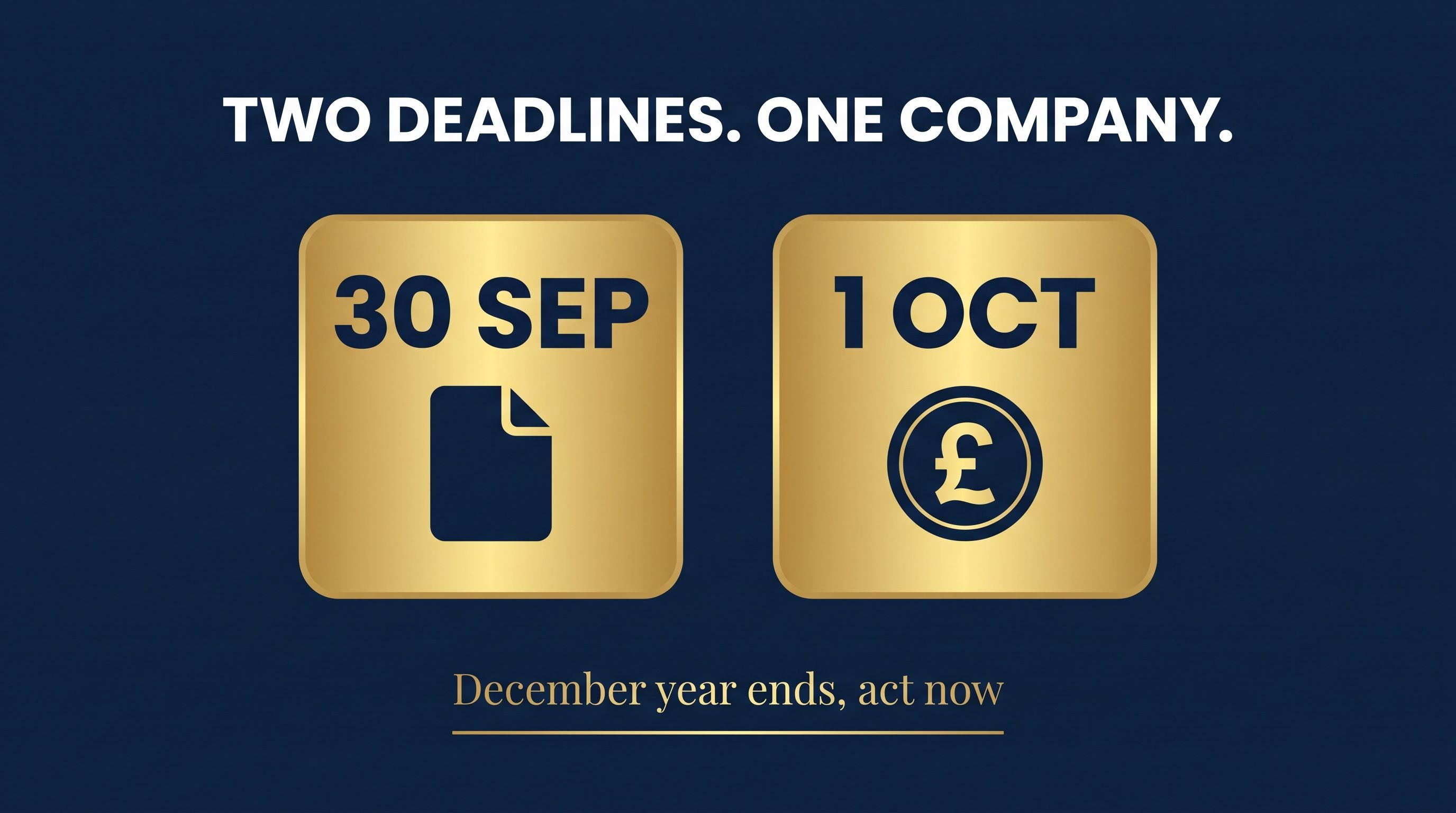
If your company's financial year ended on 31 December 2025, the next five weeks matter. Your annual accounts must reach Companies House by 30 September 2026, and your Corporation Tax must be paid by 1 October 2026. A 31 December year end is the most common choice after the standard March date, so this covers a large share of small UK companies.
The catch is that these are two separate obligations, owed to two different bodies, with two different penalty regimes, and directors regularly mix them up. The most expensive confusion is assuming the tax is due when the tax return is filed. It is not: the return can wait until December, but the money cannot. Here is how the pieces fit and what to do now.
In a nutshell
- Two deadlines, two different bodies. Companies House wants accounts, HMRC wants money.
- Accounts are due nine months after year end. For 31 December that means 30 September.
- The tax is due before the tax return. Payment first, CT600 filing later.
- Late accounts trigger automatic penalties. From £150, doubling for repeat lateness.
- Late tax mainly costs interest. Currently 7.75% a year, and it adds up.
- Cash short? Ask for Time to Pay. A normal, accessible arrangement, not a last resort.
1. Two deadlines, two different bodies
The confusion starts with the fact that a limited company answers to two regulators at once. Companies House wants your annual accounts, the statutory financial statements that go on the public record. HMRC wants your Corporation Tax, first the payment, and later the CT600 tax return that explains the calculation.
For a company with a 31 December 2025 year end, the calendar looks like this: accounts to Companies House by 30 September 2026, Corporation Tax paid by 1 October 2026, and the CT600 filed by 31 December 2026. Three dates, and the tax return is deliberately last. One scoping note: this article is about small and medium companies. If your profits exceed £1.5 million, you are in the quarterly instalment regime and your payment dates are different.
2. The 30 September accounts deadline
Private company accounts are due at Companies House nine months after the end of the financial year. Year end 31 December 2025, deadline 30 September 2026. It is that mechanical.
Two exceptions worth knowing. A company's first ever accounts work differently: they are due 21 months after incorporation, not nine months after year end, so a brand new company should not simply copy this article's dates. And an extension is possible, but only if you apply before the deadline and have a genuine reason, such as an unforeseen event. It is not a routine escape route, and applying after the date is too late.
The nine month gap sounds generous, and it is, right up until August, when accountants' inboxes fill with December year ends all at once. The earlier your records arrive, the more scope there is to do the job properly rather than at a sprint.
3. The 1 October Corporation Tax payment
Corporation Tax is due nine months and one day after the end of the accounting period. For 31 December 2025, that is 1 October 2026.
Note what this means: the payment comes before the return. The CT600 does not have to be filed until 31 December 2026, but HMRC still expects the right amount of money three months earlier. In practice that means the tax computation needs to be done, or at least reliably estimated, well before the filing deadline, which is another reason the accounts cannot wait until autumn.
The practical sequence is: finish the accounts, compute the tax, pay by 1 October, file the CT600 when ready. Companies that treat the December filing date as the trigger for everything discover the interest clock has been running since October.
4. What late filing actually costs
Late accounts at Companies House attract automatic penalties, applied by reference to how late you are: £150 up to one month, £375 between one and three months, £750 between three and six months, and £1,500 beyond six months. If your accounts are late two years in a row, the penalty doubles. Appeals succeed only in genuinely exceptional circumstances, so the working assumption should be that a missed date costs money.
The CT600 has its own, separate late filing regime, and the figures changed recently: for filing deadlines from 1 April 2026 the flat penalty is £200 the day after the deadline and another £200 at three months (double the old £100 amounts). File late three accounting periods in a row and those become £1,000 each. At six months HMRC estimates your bill and adds 10% of the unpaid tax, with another 10% at twelve months. Older articles still quote £100, so be careful what you read.
5. What late payment actually costs
Here is the part that surprises directors: for most small companies, paying the Corporation Tax itself late does not trigger a flat penalty. What it triggers is interest, charged daily from 1 October until the money arrives.
The rate is currently 7.75% a year (it tracks the Bank of England base rate plus four percentage points, so it moves when the base rate does). That is not trivial: on £10,000 of tax it works out at roughly £64 a month. Modest for a week's slippage, real money over a quarter, and unlike a penalty there is no appeal, because interest is simply the price of the delay.
Keep the two regimes straight, because that is where the confusion bites: filing late brings penalties, paying late brings interest, and letting both happen brings both.
6. What to do in the next fortnight
A short sequence that removes all of the drama:
- Get your records to your accountant now. Bank statements, sales invoices, purchase invoices and receipts, payroll records, loan statements, and details of anything unusual in the year.
- Ask for the tax figure early. You want the Corporation Tax number in September, so the payment on 1 October is a transfer, not a scramble.
- Set the cash aside as soon as the figure is known.
- If cash is genuinely short, ring HMRC before the deadline. A Time to Pay arrangement spreads Corporation Tax over instalments. There is no online self-serve route for Corporation Tax, so it is a phone call to HMRC's Payment Support Service on 0300 200 3835. Interest still runs, but the pressure comes off.
- File the CT600 when it is ready, comfortably before 31 December.
A worked example: Nowak Construction Ltd
Nowak Construction Ltd has a 31 December 2025 year end and made a profit that produces a £12,000 Corporation Tax bill. The director assumes everything is due when the tax return is filed in December, so the records go to the accountant in late October.
The consequences arrive in layers. The accounts miss 30 September, so Companies House charges an automatic £150, rising to £375 if the delay stretches past a month. The tax misses 1 October, so interest runs at 7.75%, about £77 a month on £12,000. By the time everything is sorted in early December, the company has paid roughly £530 in penalties and interest for nothing: no extra tax, just lateness.
The same company handing its records over in early September pays £0 extra, and if cash had been tight, one phone call would have set up instalments before the deadline rather than explanations after it.
Things to watch out for
- The tax return deadline is a trap. Payment is due 1 October; the December CT600 date does not delay it.
- First accounts are different. A new company's first deadline is 21 months from incorporation.
- Extensions must be requested before the deadline. And need a genuine reason.
- Repeat lateness escalates. Companies House doubles the penalty, and HMRC's flat penalties rise to £1,000 after three late periods.
- Larger companies are outside these dates. Profits over £1.5 million mean quarterly instalments.
How Ollen Services Can Help
If your company has a December year end and the records are still in a folder, this is the moment to hand them over. We prepare and file the accounts, compute the Corporation Tax so you know the figure well before 1 October, file the CT600, and if cash is tight we help you agree Time to Pay with HMRC before the deadline rather than after it.
September is our busiest month for December year ends, and the earliest records get the calmest treatment. We work in English and Polish.
Call us on 07513 491 259 or email hello@ollenservices.co.uk. Five weeks is plenty, if you start this week.